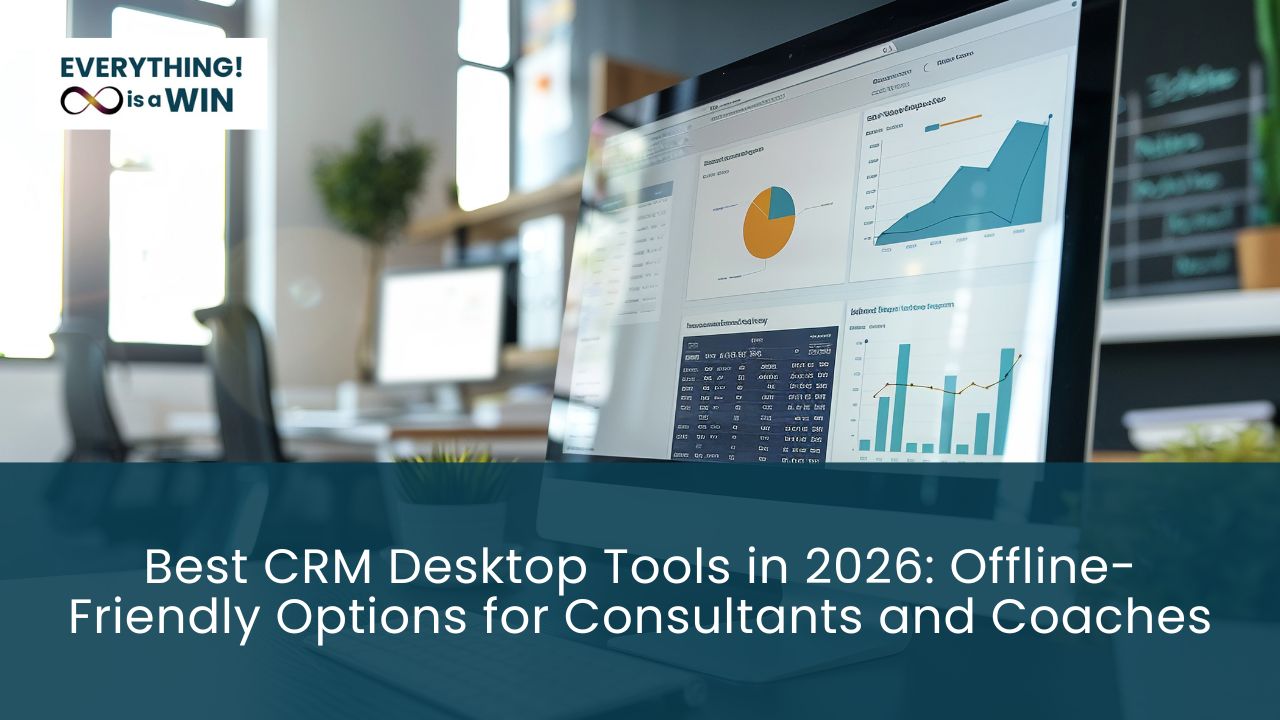
Best CRM Desktop Tools in 2026: Offline-Friendly Options for Consultants and Coaches
Most CRM tools today assume you are always online, always switching tabs, and always connected to multiple systems at once.
But that is not always how consultants and coaches actually work.
Sessions happen between meetings. Notes get added on the go. Follow-ups often need to be logged quickly without waiting for stable internet or opening five different tabs.
That is where the best crm desktop solutions still matter in 2026.
Not because cloud systems are "bad," but because some workflows simply need stability, speed, and direct access from your own computer.
For many professionals, the challenge is not lack of tools.
There are too many moving parts.
And that is exactly where desktop CRM still plays a role.
Key Takeaways
Desktop CRMs support offline access and stable client management
They are useful for consultants and coaches working across locations
Operational crm software focuses on daily execution, not just storage
Cloud CRMs are common, but desktop tools still solve specific workflow needs
The real priority is clarity in how you manage clients, not feature count
A CRM should support your workflow, not interrupt it
What Is a Desktop CRM and Why It Still Matters
A desktop CRM is software installed directly on your computer instead of running entirely in a browser.
Unlike cloud-based systems, it allows you to access and manage client information locally.
In simple terms, the best crm desktop tools are often chosen by professionals who want:
Faster access without logging into a browser
Local data control and storage
Less dependency on internet stability
A focused workspace with fewer distractions
This becomes especially useful when you are moving between sessions, working offline, or managing client notes in real time.
The goal is not complexity.
It is consistent.
So your client management does not break just because your connection does.
What Is CRM Manager in Simple Terms
To understand CRM systems properly, it helps to first answer a simple question: what is crm manager?
A CRM manager is the role responsible for keeping client data, communication, and follow-ups organized inside a system.
This includes:
Maintaining accurate client records
Tracking conversations and follow-ups
Managing pipelines and opportunities
Making sure nothing falls through the cracks
In larger companies, this is a dedicated role.
In coaching or consulting businesses, this responsibility usually sits with the business owner.
Which means you are both using the system and managing it.
That is why simplicity and structure matter more than advanced features.
Operational CRM Software and Daily Business Use
Not all CRM systems are designed for the same purpose.
This is where operational crm software becomes important.
Instead of focusing on reports or long-term analysis, it focuses on day-to-day execution.
It helps with:
Managing active leads
Tracking client communication
Sending follow-ups and reminders
Keeping pipelines moving forward
In simple terms, it supports what is happening inside your business right now.
For coaches and consultants, this is critical.
Because client work is not static.
It depends on timing, follow-through, and consistency.
Without that structure, things start slipping quickly.
Examples of CRM in Desktop and Hybrid Setups
Looking at examples of crm helps make the concept more practical.
Here are common setups used in service-based businesses:
Contact management systems for storing client details
Pipeline-based CRMs for tracking leads and deals
Desktop-installed CRM tools for offline access
Hybrid CRMs that sync between desktop and cloud
Each setup solves a slightly different need.
But they all focus on the same outcome.
Keeping client relationships organized so follow-ups do not get missed.
Desktop vs Cloud CRM: What Actually Matters
Most modern CRMs are cloud-based. That has become the default.
But desktop CRMs still matter in specific situations.
Desktop CRM strengths:
Works without constant internet access
Faster local performance
More control over stored data
Fewer distractions during focused work
Cloud CRM strengths:
Automatic syncing and backups
Easier collaboration
Broader integrations
For most coaches and consultants today, cloud systems are more practical overall.
But desktop tools still serve a purpose when stability and offline access matter most.
The real decision is not about which is better.
It is about what supports your workflow without friction.
Choosing the Right CRM for Coaches and Consultants
Most people start by comparing features.
But the more useful question is:
Does this actually match how I run my business every day?
A good CRM should:
Match your client flow
Reduce manual tracking
Support consistent follow-ups
Stay simple enough to use daily
If a system feels complicated at the beginning, it rarely becomes easier later.
Instead, it becomes another tool you avoid using.
And that defeats the purpose entirely.
Systems Over Tools
The real shift happening in 2026 is not desktop versus cloud.
It is disconnected tools versus connected systems.
Because a CRM should not sit in isolation.
It should support your entire workflow, communication, scheduling, follow-ups, and client management working together in one place.
This is where Everything Is a Win™ comes in.
Instead of managing separate tools for each part of your business, it focuses on building one connected operational system.
So your CRM, communication, and client workflows are not scattered.
They work together in a single flow that reflects how your business actually runs.
Conclusion
The best CRM desktop tools still have value in 2026, especially for consultants and coaches who need offline access and stable client management.
When you understand operational crm software, the role of a crm manager, and real examples of crm, the decision becomes much clearer.
It is not about choosing the most advanced system.
It is about choosing one that fits your workflow.
Because the right CRM should make your business easier to manage, not more complicated.
Everything Is a Win™ helps move beyond disconnected tools by bringing client management, communication, and operations into one connected system designed for real-world coaching and consulting workflows.
If your current setup feels scattered or harder to manage than it should be, Everything Is a Win™ helps you simplify it into one system that actually supports your day-to-day client work.
FAQs
1. What is the best CRM desktop software for small businesses?
The best CRM desktop software depends on workflow needs, but it should support offline access, client tracking, and simple pipeline management without unnecessary complexity.
2. Can you use a desktop CRM without the internet?
Yes, most desktop CRMs allow offline use for data entry and management. However, syncing and updates may require internet access later.
3. Does Everything Is a Win™ recommend desktop or cloud CRM systems?
Everything Is a Win™ focuses on workflow first, helping businesses choose based on how they operate rather than pushing a specific type of tool.
4. How does Everything Is a Win™ help with CRM decisions?
It looks at your daily workflow and helps determine whether stability, accessibility, or scalability matters most so your CRM actually fits your business instead of complicating it.